Last updated November 18, 2026





Free written scope consultation - allowances, timeline, and change-order rules on paper before a single trade is scheduled
Driveway & Pavers Troubleshooting: Common Problems and How to Fix Them
If you’ve re-sanded the same sunken paver section twice and it keeps coming back, you haven’t fixed the problem – you’ve just been feeding it. That’s the hard truth about most driveway and paver failures. What looks like a surface issue is usually a base failure wearing a surface disguise, and every bag of sand you dump into the gap buys you a couple of months before the same low spot returns. In Buena Park, where clay-heavy soil and dry summers put constant stress on hardscape, we see this pattern on driveways all over the city. This guide teaches you to read what your driveway is actually telling you: how to tell a DIY-able sand fix from a stop-and-call-a-pro subbase failure, what white staining signals about water, how crack patterns point to tree roots versus soil movement, and where the line sits between a smart repair and money down the drain.
Quick Answer
Most driveway paver problems in Buena Park come down to one of three root causes: a settled sand bed (fixable with re-sanding and leveling), a failed subbase or edge restraint (a contractor job), or water migrating where it shouldn’t (a drainage problem). Before you touch a single paver, run a 10-minute inspection to identify which one you’re dealing with. Patching the surface without fixing the base guarantees the same failure returns within two seasons.
Styles & brands we work with
- Kitchen remodeling
- Bathroom remodeling
- Home additions & ADU
- Roofing
- Windows & doors
- Driveway & pavers
- Fence
Table of Contents
- Read the Signs: A 10-Minute Inspection That Tells You Everything
- Sunken Pavers and Sand-Bed Settlement
- Efflorescence: What the White Staining Actually Means
- Crack Patterns: Tree Roots vs. Soil Movement vs. Heaving
- Edge Restraint Failure: The Hidden Cause of Most Paver Spread
- Drainage Problems and Water Migration
- Repair vs. Replacement: The Cost Threshold Where Repair Stops Making Sense
- Seasonal Maintenance for Buena Park Driveways
Read the Signs: A 10-Minute Inspection That Tells You Everything
Before you decide whether to grab a shovel or a phone, spend ten minutes reading your driveway. The surface is a report card; the base is the student who earned the grade. Start at one corner and walk the full perimeter slowly. You’re looking for four things: vertical movement (pavers that rock when you step on them), horizontal movement (gaps opening or closing), color changes (staining or efflorescence), and crack patterns in adjacent concrete or in the pavers themselves.
Here’s the 10-minute inspection sequence we recommend to every homeowner who calls us about a problem area:
- Walk the edge. Press your foot against the outer row of pavers. If the edge moves a half-inch or more, or if sand is spilling out from the back of the restraint, you have edge failure. Stop here and read the edge restraint section below.
- Rock test the field. Step on each paver in the problem zone. Any paver that rocks or sounds hollow is sitting on a void. That’s a sand-bed issue at minimum, potentially a base failure.
- Check the slope. Lay a 4-foot level across the driveway surface in two directions. Water should drain away from the house and garage at roughly 1/8 to 1/4 inch per foot. Flat spots or reverse slope mean water is pooling where it shouldn’t.
- Look for white haze. Run your hand across the pavers. If your palm comes up chalky or you see milky white film, note where it’s concentrated. See the efflorescence section below.
- Photograph everything. Take pictures of each problem area with a tape measure or a shoe next to it for scale. If you end up calling a contractor, those photos save an hour of guessing.
In Buena Park, we see more edge failures than anything else, because the city’s soil profile shifts with our dry-wet cycles. A properly bedded driveway in a wetter climate can last decades; here, the clay subgrade under a poorly restrained edge will move a paver field sideways in two or three summers. When in doubt, our driveway & pavers service in Buena Park starts with an inspection before any repair plan is quoted.
Sunken Pavers and Sand-Bed Settlement
A sunken paver or a small low spot in an otherwise stable field is the most fixable problem on this list. Sand-bed settlement happens for one of three reasons: the original sand was never fully compacted, water washed into the joint sand and carried fines down into the base, or a nearby downspout or planter is dumping water into that corner of the driveway. The fix is straightforward – but only if the base underneath is intact.
Here’s how to tell whether you can handle it yourself or need a contractor:
- DIY territory: One to three pavers, movement under a quarter-inch, no visible crack in the pavers, no heaving at the joints, base layer solid when you pull the affected paver up (you’ll see compacted gravel, not loose dirt).
- Stop and call a pro: Five or more pavers affected, movement over a half-inch, movement that returns after re-sanding, or once you pull a paver and find loose soil, hollow space, or water weeping up from the base.
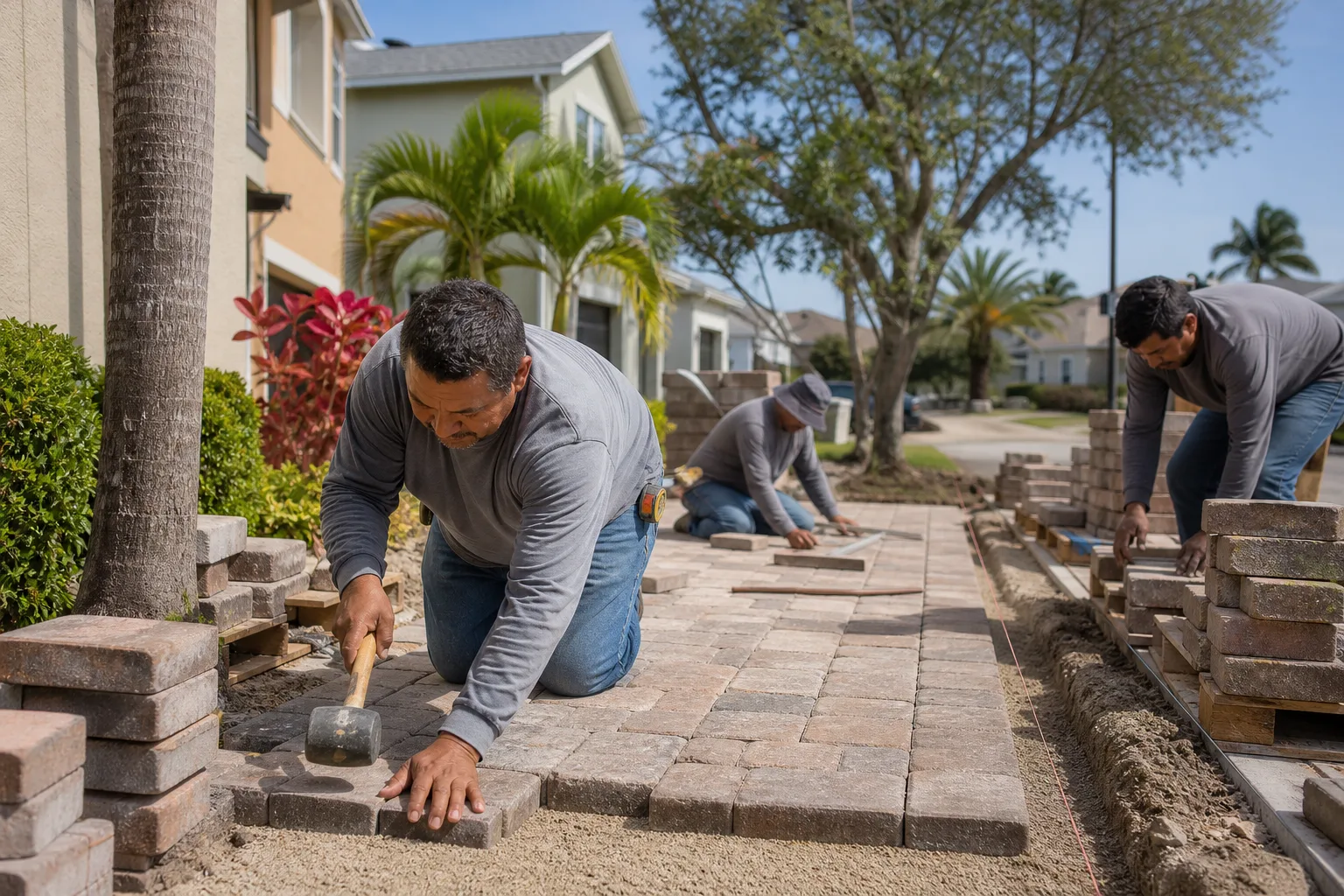
If you’re in DIY territory, the repair is a lift-and-reset: pry up the affected pavers with a flat bar, remove the old bedding sand down to the compacted base, re-gravel and re-sand with a material like Sakrete paver sand, compact with a hand tamper, then reset the pavers and re-fill joints. Sweep and water the joints, walk the area, and check after two weeks. If the pavers have settled again by then, the base is your actual problem.
Sakrete makes a paver-specific joint sand that locks better than all-purpose sand in our dry-summer climate, and we specify it on most Buena Park re-sand jobs. But sand is only as good as what’s under it. In our experience, a homeowner who re-sands the same spot for the third time is spending more on sand than a proper base repair would have cost on the first round. That’s exactly why we lead with the 730-Day Done Right Promise on every driveway and paver job – if a repair fails because of our workmanship, we come back and make it right. That’s a written commitment, not a handshake.
Efflorescence: What the White Staining Actually Means
Efflorescence is the white, powdery staining you sometimes see on concrete pavers, block, or mortar. It’s not mold, it’s not damage, and you can’t scrub it permanently away with a wire brush. It’s a salt deposit – water carried salts to the surface, the water evaporated, and the salts stayed behind. The stain itself is cosmetic; what matters is what the efflorescence is telling you about where water is moving.
Two signals matter for Buena Park homeowners:
- Cosmetic efflorescence: Light, patchy white haze on newer pavers, especially after a wet winter or a recent cleanup. This is normal curing behavior and usually resolves with two or three wash cycles and time.
- Structural signal: Heavy, recurring, or concentrated efflorescence along a joint line, near the edge, or over a crack. That’s water pushing through the base or from a broken drainage path, and the pavers are the only place it can escape.
The quick test is simple. Scrub a small area with a stiff brush and a diluted white vinegar solution (1 part vinegar to 4 parts water). Rinse with clean water and check again in two weeks. If the stain doesn’t return, it was cosmetic. If it comes back in the same pattern, you have a moisture migration problem, and re-sanding or sealing the pavers will lock the salt in and make it worse.
Sealing isn’t the answer to efflorescence – proper drainage and base repair is. We’ve watched homeowners spend hundreds on penetrating sealers trying to stop white staining, only to have it reappear three months later because the water was entering at the edge restraint, not the surface. Fix the water path, then the stain fades on its own.
Crack Patterns: Tree Roots vs. Soil Movement vs. Heaving
A crack in a paver or a heave in the field is diagnostic. Different forces produce different patterns, and reading the pattern correctly saves you from repairing the wrong thing.
Tree root intrusion. Look for cracks that appear in a line parallel to a nearby tree trunk, with pavers lifting in a curved or arcing pattern. You’ll often see one specific paver pushed up higher than its neighbors, with joint sand blown out on the high side. Root intrusion is common in older Buena Park neighborhoods where mature ficus, eucalyptus, and sycamores sit within 10 feet of the driveway edge. If the root is under a quarter-inch in diameter, the paver can sometimes be lifted and reset with the root cut back. Anything larger risks destabilizing the tree and the driveway both, and that’s a conversation for an arborist and a paver crew.
Soil erosion. Look for a low, dish-shaped depression that follows an invisible line – often the path a downspout takes, or the low point of a slope. Cracks appear at the edges of the depression, and pavers sink rather than lift. Buena Park’s clay-heavy soil is prone to this after a wet winter, especially if the driveway was originally built without proper underdrain.
Freeze-thaw heaving. Rare in coastal Southern California but real in Buena Park’s inland pockets on cold January nights. Look for vertical lifting that spreads across a wide area rather than concentrating at one point, with joint sand loosening across the whole affected section. Heaving is a symptom of water trapped in the base layer freezing and expanding, which means the repair is drainage and base, not pavers.
If you see more than one pattern in the same area, that’s a strong sign the base has been compromised. Stop patching and get a professional assessment. Our technicians have up to 12 years of experience reading these patterns, and we can usually tell from a 15-minute walkthrough whether you’re looking at a top-layer fix or a rebuild.
Edge Restraint Failure: The Hidden Cause of Most Paver Spread
Edge restraint is the invisible trim along the perimeter of a paver field – usually a plastic, aluminum, or poured-concrete lip that holds the outer row in place. When it fails, the entire field can shift sideways, joints widen, and pavers spread like a slow-motion landslide. In our experience, edge restraint failure is the hidden cause behind an enormous share of paver spread we see on Buena Park driveways, and it’s almost never diagnosed by homeowners because it happens out of sight.
Here’s how to check yours in under five minutes:
- Walk the full perimeter of your driveway with a flashlight, even in daylight.
- Press your thumb against the outer row of pavers at every 6 feet. Any give or movement means the restraint is failing.
- Look for sand spilling out from behind the outer row. That’s a sure sign the restraint has separated from the base.
- Check your driveway apron where it meets the street and the sidewalk. If pavers are pushing out past the concrete edge, the restraint has failed there.
- Look for widening joints along one full edge of the field. If the joints on the east edge are tighter than on the west edge, the west edge restraint is probably gone.
Once the edge goes, the field follows. Resetting the pavers without fixing the restraint buys you time, not a repair. A proper edge repair means removing the outer row, digging back to the compacted base, installing a new restraint anchored into the base material, and re-bedding the pavers. In Buena Park, we also check that the restraint top clears your mow strip and any adjacent landscaping, because a restraint set too proud becomes a trip point and a future failure all at once.
Drainage Problems and Water Migration
Water is the chronic driver behind nearly every problem in this guide. Buena Park’s dry summers mean that when rain does come, it comes hard and fast, and it finds every weakness in the base. The three water paths we see most often on Buena Park driveways are:
- Downspout dumping. A single gutter downspout discharging directly onto pavers can move enough water in one storm to erode a base pocket under a 3-foot circle.
- Slope failure. Driveways originally built with the wrong drainage slope, or with reverse-pitched sections, pool water in low spots that soften the base over time.
- Missing or failed underdrain. Driveways that should have had a French drain under the base but didn’t get one, or where the drain has clogged with roots and silt.
The visual cues are consistent: efflorescence over a joint line, moss or algae growth in one concentrated area, joint sand that washes out every rain, and pavers that stay visibly dark for days after rain while the rest of the driveway dries. Any one of those signals means water is moving where it shouldn’t. A simple fix like extending a downspout with an underground drain line or re-grading a planting bed can solve the problem in an afternoon. A driveway with failed slope or missing underdrain is a rebuild conversation.
Repair vs. Replacement: The Cost Threshold Where Repair Stops Making Sense
This is the question every homeowner eventually asks, and the honest answer is that repair and replacement aren’t competitors – they’re different tools for different stages of failure. Here’s the rough breakdown we share with Buena Park homeowners before any quote:
- Small repair (re-sand, reset a few pavers, spot level): under $400 in most Buena Park cases, and often less if you do the sand-work yourself.
- Mid-scope repair (edge restraint replacement, 10 to 20 pavers, base spot-repair): roughly $800 to $2,500 depending on linear feet and paver access.
- Partial rebuild (one section, new base, new pavers matching existing): roughly $3,000 to $7,000 for a typical two-car driveway section.
- Full driveway replacement: ranges widely with materials and square footage, often $9,000 to $25,000 for a standard Buena Park driveway, more if excavation or drainage work is extensive.
The rule we use: if repairs would consume more than 30% of the cost of replacement and the driveway is already showing three or more failure types, replacement is the better long-term spend. A 15-year-old driveway with one sunken section is a repair. The same driveway with edge failure, root intrusion, and efflorescence is a rebuild wearing a repair bill.
Whatever you choose, get a written line-item quote that separates labor, material, and disposal. No-hassle upfront pricing means the number on the estimate is the number on the invoice, and if it changes, the change is written down before work starts. That’s the standard we hold ourselves to on every driveway and pavers project in Buena Park, and it’s the standard you should hold any contractor to.
Seasonal Maintenance for Buena Park Driveways
Preventive maintenance is cheap; repair is expensive. Here’s the annual routine we recommend to keep Buena Park pavers stable through the dry-wet cycle:
- Fall (October – November): Clear all downspouts and check discharge locations. Extend any downspout that dumps onto pavers so water lands on landscaping or a drainage channel instead.
- Before the first big rain (typically December): Top off joint sand in any areas that look low. Sweep sand into the joints and water it in. This is the single best defense against base erosion.
- Spring (March – April): Walk the perimeter and press on the edge restraint. Re-set any paver that rocks. Spot-treat any efflorescence with a diluted vinegar wash.
- Summer (July – August): Check for weeds in the joints – pull by hand, don’t use a pressure washer, which blasts out the joint sand and destabilizes the pavers.
- Every 5 – 7 years: Have a contractor inspect the base and edge restraint, especially if the driveway is over 10 years old or sits under mature trees.
A driveway paver surface, like any hardscape, will eventually need attention. The difference between a driveway that lasts 25 years and one that fails in 8 is almost always maintenance, not material quality – and Groundwork Construction Co. of Buena Park builds every driveway with that maintenance path in mind, using brand partners like Belgard for pavers and Sakrete for bedding and joint materials so the repair work later uses the same spec as the original install.
Common Mistakes to Avoid
- Re-sanding without diagnosing the base. If the same sunken section keeps returning, sand isn’t the fix. You’re burying the symptom, and eventually the base failure will spread.
- Pressure washing the joints. High-pressure water blasts the joint sand out and destabilizes the paver field. Use a garden hose and a soft-bristle broom instead, and re-sand any time joints look visibly low.
- Cutting tree roots to fix a heave. Cutting a structural root can kill or destabilize a mature tree, and in Buena Park that tree may be protected. Get an arborist assessment before any root work.
- Sealing too early or too often. Sealing new pavers before they cure traps moisture, and sealing a driveway with active efflorescence locks the stain in for good. Address water migration first.
- Ignoring edge restraint because it’s out of sight. This is the biggest single cause of paver spread we see on Buena Park driveways. Check it before it becomes a full-field problem.
- Hiring on a verbal quote. Get a written line-item estimate with labor, material, and disposal separated. The number you see should be the number you pay, in writing.
- Assuming freeze-thaw heaving is impossible here. Buena Park’s inland pockets hit freezing on cold January nights, and trapped water in the base will heave pavers. Don’t dismiss it just because we’re in Southern California.
See the difference
 Before
 After
 Before
 After
 Before
 After
When to Call a Professional
Some pavers problems are safe to handle yourself. Others need a trained eye and a proper base repair. Call a professional when you see more than five affected pavers, movement over a half-inch, edge restraint give anywhere along the perimeter, efflorescence that returns after cleaning, cracks that trace a line toward a tree, or any area of the driveway where water visibly pools after a storm. Also call if the affected area is within 20 feet of a foundation, since water migration toward the house is a separate problem you don’t want to bury under new sand. Groundwork Construction Co. of Buena Park offers free estimates in Buena Park – call (833) 522-5059 and we’ll walk the driveway with you, tell you honestly what you’re looking at, and quote a repair or replacement with upfront pricing and no surprises. Every one of our technicians is background-checked and uniformed, and every job is backed by the 730-Day Done Right Promise.
Frequently Asked Questions
A sand issue shows up as one to three loose pavers with under a quarter-inch of movement in an otherwise stable field. A base failure shows up as five or more affected pavers, movement over a half-inch, return of the same problem after re-sanding, or hollow spots under multiple pavers. If you pull one paver and see loose dirt or water under it instead of compacted base, that’s a base failure. Call (833) 522-5059 for a free diagnostic walkthrough before you spend another dollar on sand.
White staining on pavers is called efflorescence – salt deposits left behind when water evaporates from the paver surface. Light patchy staining on newer pavers is cosmetic and fades with normal weathering. Heavy, recurring, or joint-line-concentrated staining signals that water is migrating through the base, which is a real problem. Clean a test patch with diluted vinegar and check back in two weeks: if the stain returns, that’s your signal to call us at (833) 522-5059.
Paver spread along one edge almost always means edge restraint failure. The restraint is the plastic, aluminum, or concrete lip that holds the outer row of pavers in place – when it fails, the whole field can shift sideways and joints widen. Press against the outer row at every few feet: any give means the restraint needs replacing. Call (833) 522-5059 for an edge restraint assessment before the whole field moves.
Most small Buena Park paver repairs run under $400, mid-scope repairs usually fall between $800 and $2,500, partial rebuilds roughly $3,000 to $7,000, and full driveway replacement typically ranges from $9,000 to $25,000 depending on material and square footage. Those ranges are estimates, not quotes – real pricing depends on what the base looks like under your specific driveway. Call (833) 522-5059 for a free written estimate with itemized labor and material.
A low spot that returns after re-sanding means the base under it is compromised – either eroded by water, uncompacted from the original install, or undermined by tree roots. Re-sanding fills the surface gap but doesn’t repair the base. A proper fix means lifting the affected pavers, rebuilding the base layer with proper compaction and drainage, and resetting. Call (833) 522-5059 and we’ll diagnose it in one visit.
Small roots (under a quarter-inch) can usually be trimmed back during a paver reset without harming the tree. Larger roots require an arborist assessment first, especially in Buena Park where some mature trees carry local protection. The repair itself may involve cutting a root barrier along the driveway edge to prevent future intrusion, then rebuilding the base in that section. Call (833) 522-5059 and we’ll walk you through the options after seeing the tree and the affected pavers.
The Bottom Line
Most driveway paver failures aren’t surface problems – they’re base failures showing through the surface. Before you grab a bag of sand, run the 10-minute inspection: walk the edge, rock-test the field, check the slope, look for white staining, and photograph anything that looks wrong. Small settlement is fixable in an afternoon. Base failure, edge restraint failure, and water migration need a proper repair that fixes the bottom before the top. When the diagnosis points to a repair beyond DIY scope, call Groundwork Construction Co. of Buena Park at (833) 522-5059 for a free estimate. Our technicians have up to 12 years of experience reading paver failures, every job is backed by the 730-Day Done Right Promise, and the number we quote is the number you pay – upfront pricing with no surprises. From foundation to finish line, we build driveways that stay put in Buena Park’s soil and climate.
When your project grows beyond the driveway, we handle the full scope from start to finish: fence installation in Buena Park to match new hardscape, home additions and ADUs in Buena Park for growing households, and everything in between. One contractor, one warranty, one point of accountability backed in writing.
Call (833) 522-5059 to schedule your free estimate. A live person answers 24/7, every technician who shows up is background-checked and in uniform, and the estimate you receive is a written, itemized quote – not a guess. Ask about our $1,000 off projects over $10,000 and 0% financing for 18 months while you’re at it. Whether your driveway needs a small fix or a full rebuild, we’ll tell you which one is honest and quote it straight.
Written by the team at Groundwork Construction Co. of Buena Park.